

Ginkgo
Ginkgos are grown as hedges in China to supply the leaves for western herbal medicine. There are several gingkos growing in our Outdoor Gardens, including one near the entrance to the Biomes.
Botanical description
- Scientific name: Ginkgo biloba
- Family: Ginkgoaceae (ginkgo)
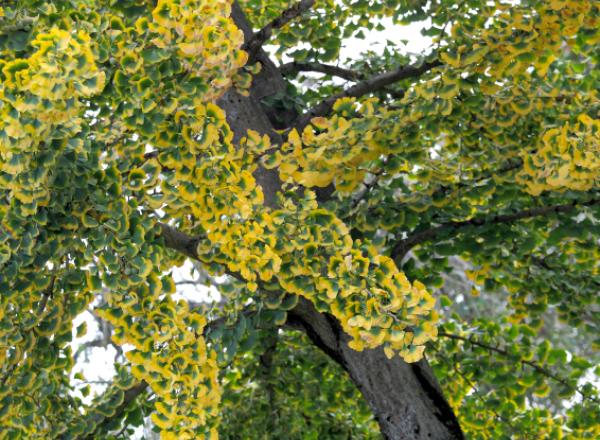
Deciduous tree up to 40m tall. Bark grey, furrowed, corky. Leaves characteristically fan-shaped, up to 12cm across, divided into two lobes, bright yellow in autumn, spirally arranged along long shoots. Each tree has either male or female flowers (dioecious): male flowers catkin-like, hanging down (pendulous) and yellow, up to 8cm long; female flowers smaller and on pedicels up to 4cm long. Fruits maturing following autumn, drupe-like, light yellow decaying to purplish-black. Pollinated by wind.
Facts
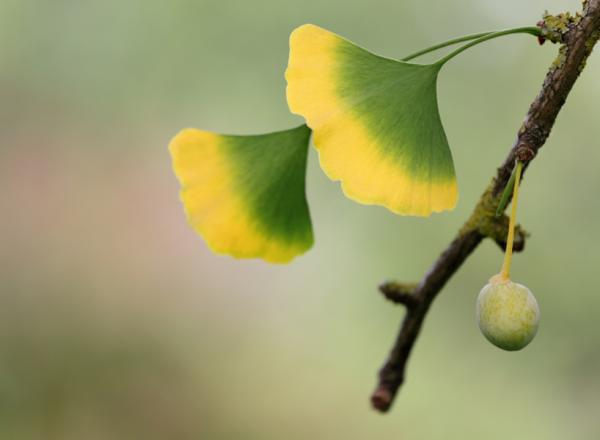
- The fruits mature after autumn and smell of rancid butter during the ripening process.
- Known as a 'living fossil', the Ginkgo biloba is one of the world's oldest living tree species: it was around 350 million years ago!
- The word ginkgo comes from the Chinese yinxing meaning 'silver apricot'. It was named the maidenhair tree in England because the leaves look similar to the native maidenhair fern.
- The leaves contain ginkgolides, which are used to improve blood circulation to the brain and to relieve Alzheimer’s, tinnitus and Reynaud's Syndrome. It is usually Europe’s number one selling herbal medication.

Where it grows
Native to Xitianmu Mountain in Zhejiang, China. Scattered in broadleaved forests up to 1,100m altitude.
Useful links
Glossary
- Deciduous: sheds all leaves annually.
- Drupe: fleshy fruit that does not spontaneously open (indehiscent) with seeds enclosed in a stony endocarp.
- Lobe: incomplete division in any plant organ (eg leaf).
- Pedicel: flower/floret stalk.


