We’ll be carrying out planned website maintenance on Tuesday 29 September from 4pm, so the website may be temporarily unavailable during this time.


Architecture
The breathtaking sight of bubble-like Biomes nestling in a former clay mine has drawn millions of visitors from around the world. Many other examples of unique and sustainable architecture can be found across the Eden site, including the plant-inspired Core building.
Gallery


Biome architecture
How Eden was designed
Quote 1
The moment we saw it we loved it, because it felt natural – a biological response to our needs, but forged in materials that would allow us to explore the cultivation of plants in a way never before attempted
Inspiration
Carousel

1
Each hexagonal window has three layers of ETFE.

2
Early sketches of Biome structural elements on napkins.

3
Architectural sketch of whole Eden site.

4
The dome structures are hex-tri-hex space frames with two layers.

5
Building Eden in a former clay mine presented many challenges.

6
Interior of Biome before planting.
Facts and figures
-
230 miles of scaffolding
...was needed in building the Biomes, and got us into the the Guinness Book of Records for using the most scaffolding! -
35 football pitches
...is the size of the area that is our Outdoor Gardens, Rainforest and Mediterranean Biomes cover, which is about 13 hectares. -
43 million gallons of rainwater
...fell in 90 days during the build. -
426 tonnes of air
... is contained in the Rainforest Biome, and the structure only weighs 465 tonnes! (Dry air at standard temperature and pressure).
Facts and figures
Timelapse of Biome and Core build
Architecture of the Core building
Jolyon Brewis of Nicholas Grimshaw and Partners designed the Core, home to our Invisible Worlds exhibition, using natural forms (biomimicry) and sustainable construction. The Core was first built in 2005 and re-imagined in 2017/18 with the new major exhibition and substantial changes to the building. This included a new Exhibitions Gallery, Café, Laboratory and two play areas in addition to a series of new art and exhibit installations. The building has also been opened up, enabling views across all floors.
Inspiration
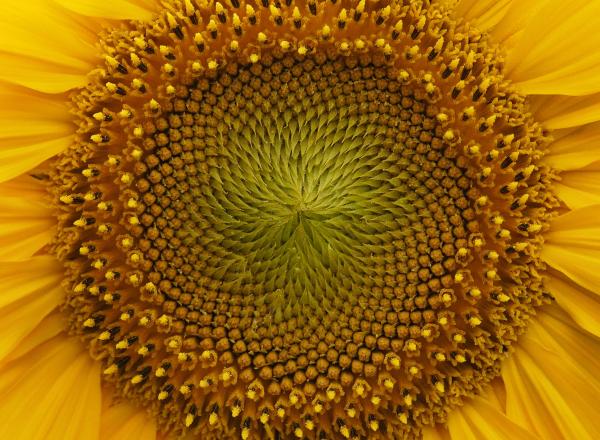
The word 'biomimicry' describes the process of humans borrowing designs and systems from nature to create their own technology. Jolyon Brewis did exactly that when he based the architecture of our Core building on the growth blueprint of plants. He used opposing spirals mathematically based on Fibonacci’s sequence (0, 1, 1, 2, 3, 5, 8, 13, 21, 34 ...) where every number is the sum of the previous two. The spirals on a pinecone, pineapple and sunflower, like the Core roof, usually represent two consecutive numbers in this sequence.
The brief asked the architect for the building to be fit for purpose, future-proof, made with responsibly sourced materials, energy efficient, and constructed with minimal waste.
Design and materials
We worked with mechanical and electrical consultants Buro Happold to reduce the environmental impact of the building as much as possible. Innovative features include energy-efficient super-insulated walls made from recycled newspaper, flooring that was originally Heineken bottles, 'designing out' the need for a lot of concrete, photovoltaic panels on the roof provide electricity and beams made from Forest Stewardship Council-certified Red Spruce.
Carousel

1
Core building under construction.

2
Solar panels on the roof of the Core building.

3
Fibonacci spirals can be clearly seen in the Core's ceiling.

Sustainable construction at Eden
Green features
Super insulation
We pioneered the use of a really good insulating material to keep our plants warm in the Biomes. The hexagonal cushions on the steel structure trap air between two layers of ETFE (short for ethylene tetrafluoroethylene) which act as a thermal blanket.
To keep our visitors and staff warm, we've insulated our buildings with recycled newspaper. We also created a green roof on top of one our staff buildings behind the scenes, which helps keep it warmer in winter and cooler in summer. Birds and insects like it too.
Energy generation
We have prioritised lowering our energy consumption rather than simply installing renewable energy technology for the sake of it. However, we did include photovoltaic panels on the Core roof to be able to demonstrate to our visitors just how powerful these natural sources of energy are.
Water harvesting
As well as reducing our water use in the first place, by installing low-flush toilets, and taps which turn themselves off, we harvest our own water to flush the loos and water the plants.
Natural light
Designing buildings that let in lots of natural light can mean electricity savings (if the windows are well insulated) as well as happier, more alert people.
There's a lot to think about when choosing construction materials – how they're made, how far they have to travel, how long they'll last. There's no one-size-fits-all solution; instead, at Eden, we try to opt for the best material in each case, weighing up different considerations, including:
Recycled materials
You can find some innovative examples of recycled building materials in the Core: the green tiles in the floor were originally Heineken bottles, the entrance mats are made from recycled truck tyres, and the cafe floor is made of reclaimed wood.
Responsible manufacturers
We talk to our suppliers about how they've manufactured the materials we buy – and in some cases have even asked them to consider doing things differently for us.
For example, the sourcing of the copper for the roof of the Core marked a new approach in the mineral supply chain that pioneered single-source traceability. Rather than obtaining copper on the open market (whose origin is mixed and cannot be determined), we worked closely with the international minerals company Rio Tinto to source it. The copper was tracked from a single source – a mine which had ISO 14001 environmental certification for environmental management systems – across the world to the fabricator KME, in Germany, and from there to its installation at Eden. Find out more in our pdf report.
Low-waste manufacturing
When we can, we go for products whose manufacturing doesn't create unnecessary waste. The beautifully curved beams you can see in the ceiling of the Core were constructed using Glulam (glue-laminated layers of timber), a strong material whose offcuts are used as a fuel.
Fewer materials
Our buildings were designed to need as few construction products as possible. For example, the Biomes' hexagons copy nature’s honeycombs: maximum strength using minimum materials.
Lower-carbon products
Construction materials can result in a lot of carbon emissions, either through an energy-intensive manufacturing process or because they have to be transported a long way to the point of use. Furthermore products sometimes aren't durable, meaning they'll need to be replaced in the near future.

Future plans
On Eden's outer estate we have plans to build a sustainably designed eco 109-bedroom hotel, offering onsite accommodation for visitors, as well as classrooms to support our educational programmes.
Designed by Tate Harmer, one of the UK’s leading architects for sustainability and natural environments, the striking plan features prominent timber poles, cladding the outside.

